February 12, 2025
Solved

Is TurboTax incorrectly reporting tax exempt income for State taxes? I believe TurboTax is under reporting tax exempt dividend income earned in other states.

  • February 12, 2025
  • 2 replies
  • 0 views
State of Michigan taxes exempt dividend income earned in other states but the tax software is underreporting the income amount
    Best answer by SteamTrain

    @jay-gardner-jr 


    Go back and edit any 1099-INT with box 8 $$ in it, and any 1099-DIV with any box 12 $$ in it.


    On a page or two AFTER the main form for each one, there will be a page that asks you to identify...which state's bonds the $$ came from......and if you indicated MI for all of it, then that's you made an error.


    1)  For the 1099-INT, with box 8 $$ in it, you would only indicate it was all MI,...only if you hold ALL MI bonds, and none form other states.

    2) for a 1099-DIV with $$ in box 12,  again you would only indicate it was all MI,...only if your bond funds only held MI-related Muni bonds...and that's unlikely

    ___________________________________

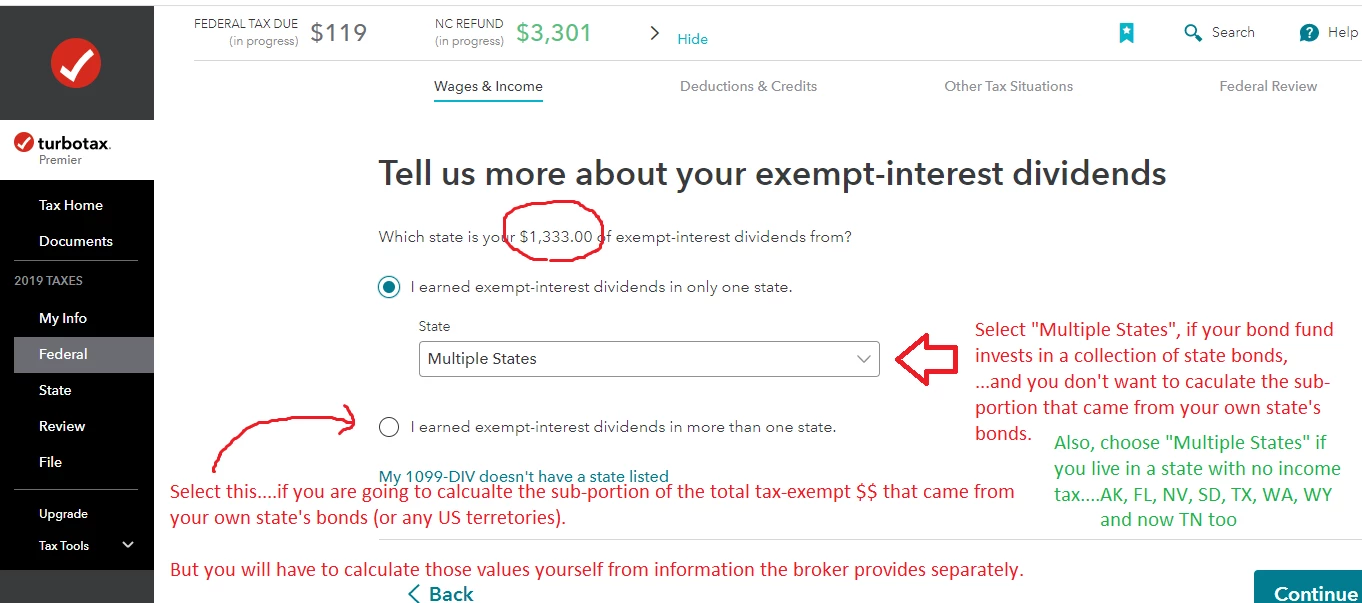
    3)  When editing those follow-up questions, if the amounts are relatively small, it may not be worth the effort to break out the MI-related bond $$, and can be simpler to mark it all as "Multiple States", by selecting the first bullet point, then going to the end of the long list of states, and selecting the final "Multiple States".  Then it all becomes MI-taxable.


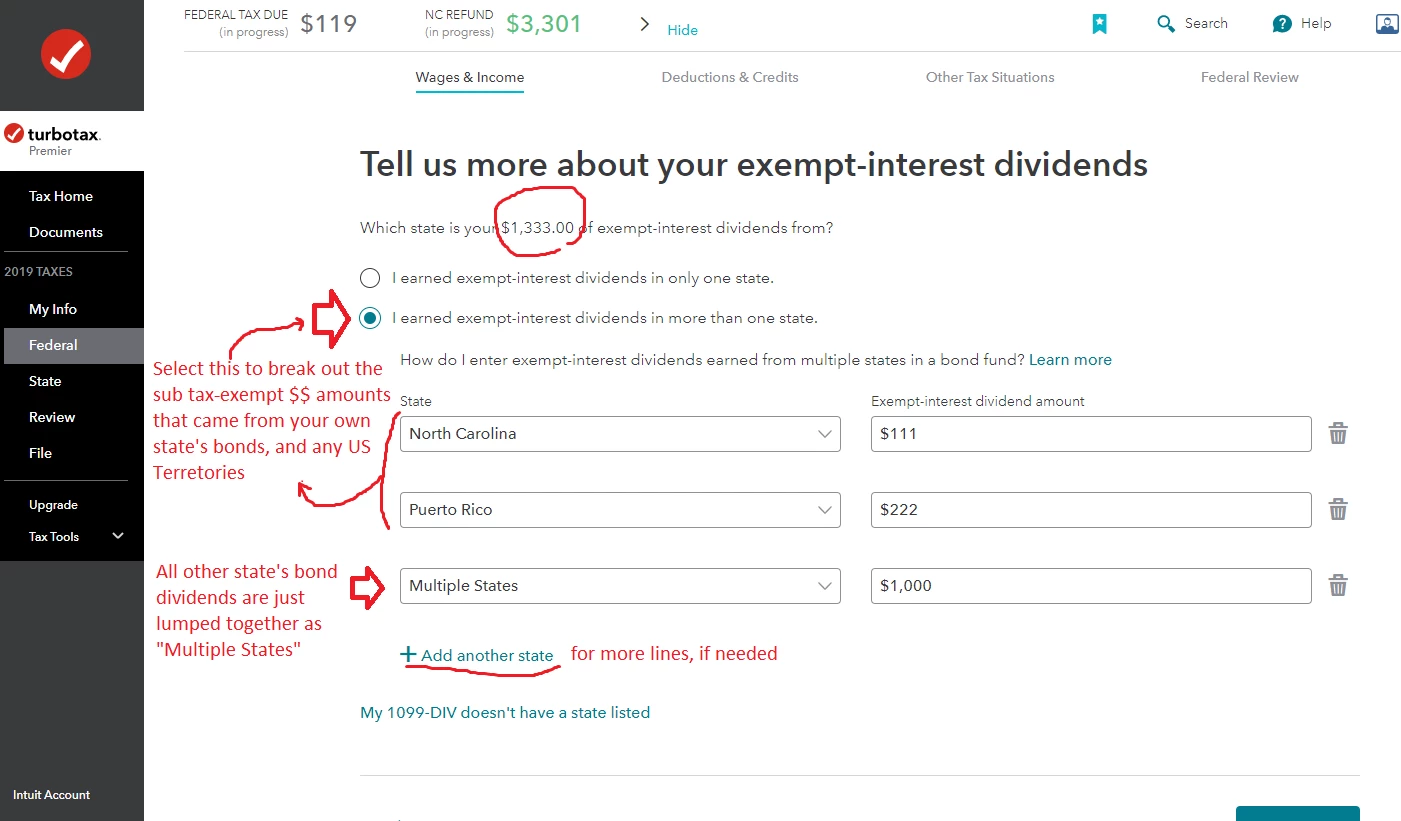
    4)  If instead, you want to break-out the MI-$$ form the rest, then you select the second bullet point, then indicate what $$ amount belonged to MI (and any US Territories), and all the rest of the $$ are assigned as a lump amount as "Multiple States"  (see below example for an NC resident):

    _____________________________
     

    _____________________________
     

    2 replies

    SteamTrain
    February 12, 2025

    @jay-gardner-jr 


    Go back and edit any 1099-INT with box 8 $$ in it, and any 1099-DIV with any box 12 $$ in it.


    On a page or two AFTER the main form for each one, there will be a page that asks you to identify...which state's bonds the $$ came from......and if you indicated MI for all of it, then that's you made an error.


    1)  For the 1099-INT, with box 8 $$ in it, you would only indicate it was all MI,...only if you hold ALL MI bonds, and none form other states.

    2) for a 1099-DIV with $$ in box 12,  again you would only indicate it was all MI,...only if your bond funds only held MI-related Muni bonds...and that's unlikely

    ___________________________________

    3)  When editing those follow-up questions, if the amounts are relatively small, it may not be worth the effort to break out the MI-related bond $$, and can be simpler to mark it all as "Multiple States", by selecting the first bullet point, then going to the end of the long list of states, and selecting the final "Multiple States".  Then it all becomes MI-taxable.


    4)  If instead, you want to break-out the MI-$$ form the rest, then you select the second bullet point, then indicate what $$ amount belonged to MI (and any US Territories), and all the rest of the $$ are assigned as a lump amount as "Multiple States"  (see below example for an NC resident):

    _____________________________


    _____________________________

     

    ____________*Answers are correct to the best of my knowledge when posted, but should not be considered to be legal or official tax advice.*
    February 13, 2025

    Thanks much for your reply to my question. When I entered the data originally , I had split the MI and non MI exempt interest and dividends per the steps you outlined.  I then verified the entries by examining Sch B to confirm the tax-exempt income had been split correctly between MI and non MI income.  BUT , Turbo Tax is under reporting the correct non MI income in my State return. Following one of your suggestions, and to test the software,  I did temporarily change the entries to 'Multiple States' only and then back to the original entries.  The result was that the income on my Michigan return did increase but not to the correct amount.  On the Michigan return, there is no way to see what is behind the income entry (Sch 1, Line 1) so I cant tell what is included or not. 

    February 13, 2025

    I believe I have found the answer to the question I posed and have concluded that the software is correctly calculating the state tax.  It turns out that TurboTax is reducing the non MI tax exempt income by the percentage that bond amortization premium represents of total tax exempt interest income.  Intuitively this makes sense but there was no way to understand or track this calculation on any of the supporting forms. It would help if I could click on the resulting reported income in the box to understand how it is calculated.

    March 16, 2025

    I am having this issue.  The number being reported on the Michigan state return is a mystery.  I have re-loaded the information for Box #8 (tax exempt interest) and for box #12 (tax exempt dividends) and re-loaded the info on the follow-on schedule requesting Michigan vs other state entries.   The result has not changed and is approximately $14K lower than it should be on the Michigan return.  I have spent hours  trying to make this work.  Any ideas?  I am using the desktop Premier edition on a PC (Microsoft).   

    March 16, 2025

    The solution for me was to make sure the state where the non (MI in your case) tax exempt income was earned is shown as "XX".  That brought that amount to my state return as taxable income.

    March 16, 2025

    Thank you.  I’m not sure what the “XX” meant, but I figured out a solution.  I reduced the tax exempt interest and dividends on the input forms by Michigan exempt amounts and on the subsequent screen, i said 100% of the amount remaining was from “multiple states”.  The correct amount then appeared on our Michigan return.  Turbotax is obviously not working correctly if we have to do that “work around “ to get the correct result.  Wonder how many incorrect returns have been filed?  

    thanks for the “idea”




